Yeah But!

It’s not my fault
Yeah, But
I thought that the fervor surrounding the Olympic Men's Hockey Final had faded away, however just the other day a colleague asked me if I had watched the big game? I know he is a huge hockey fan and it was evident that the loss was still lingering with him. It didn’t take long to hear the words “yeah but.” Clearly early morning start time for the bars has passed, and the media has mercifully mostly moved on. Yet, for many Canadians, the loss—while certainly not a tragedy (no matter what your neighbour says after three beers)—was a surprisingly sharp, gut-punching experience for many. This defeat served as a jarring reminder that our perceived moral superiority, which we sometimes incorrectly tie to our ability to put a frozen puck in a net more effectively than everyone else, might be temporarily on hiatus.
While it doesn't explicitly state that the reaction is because of "all of the current issues we face with our neighbour below us" (the US), it strongly implies a connection by framing the game as being "less about a medal and more about establishing superiority over our neighbours south of the border." The overblown, "dramatic sighing" reaction to the loss is presented as a misplaced focus, hinting that deeper, perhaps unresolved, national anxieties—potentially including those related to the US—are being funneled into the sports outcome. For sure there are a lot of anxieties, confusion, sadness and general anger that didn’t seem to exist not that long ago. I mean - I thought we were all friends? Seems that maybe we aren’t so well liked, I guess?
In Canada, we have a PhD in "Yeah, But" when it comes to hockey. The media coverage following the finals in Milan was a textbook study of this syndrome. If you read the headlines, you’d think the gold medals were stolen in a heist rather than won on the ice.
The narrative was dominated by the "Better Team" Fallacy. We pointed to the shot counts—42 to 28 in our favor—and whispered, "Yeah, but we dominated play. We were the better team for 58 minutes." When that didn't stick, we blamed the "gimmick" of 3-on-3 overtime or blamed a "hot goalie" as if world-class goaltending is an act of God rather than a deliberate part of a team's roster construction.
Perhaps we lean so heavily on "Yeah, but" because, as Canadians, we’ve developed a unique cultural immunity to the sting of second place. We aren’t like some of the fans of other nations who might burn jerseys in the street or launch vitriolic protests against the officiating. We are a "grain of salt" people. Yeah…we are polite and we smile and don’t fight back. We take our silver medals with a polite nod, a quiet sigh, and a resigned shrug that says, "Well, we’ll get 'em next time."
This lack of outward demonstration is often mistaken for a lack of passion, but it’s actually a form of national insulation. We are so used to the "almost"—the deep run that ends in a shootout, the podium finish that isn't quite the top step—that we’ve made a habit of being "the bridesmaid." We don't scream; we just rationalize. Our "Yeah, but" is the polite Canadian version of a riot. It’s our way of staying comfortable in the cold, convincing ourselves that while we didn't get the hardware, it’s okay to finish second. We own the podium for participation medals. I know that I do.
We do it to protect ourselves. We do it to bridge the gap between who we think we are and what the scoreboard says. But as I watched Canada fall to the USA in the Olympic hockey finals this month, I realized that "Yeah, but" isn't just a personal quirk—it’s a national anthem for the second-best.
I also pondered, "Am I also guilty of this?" Throughout my sporting career, did I actually take responsibility, or was I quick to say "yeah but"?
4Th Place Again!
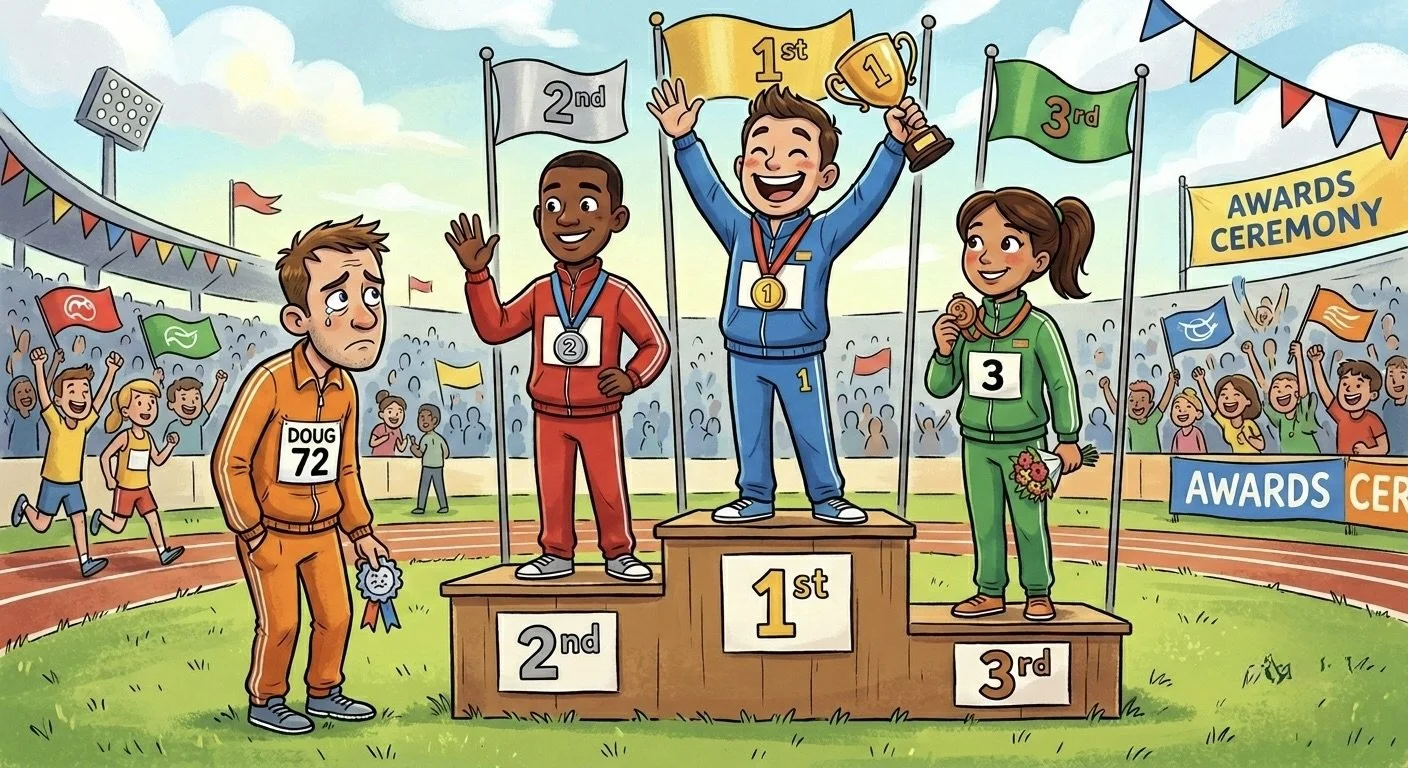
I played a significant number of pickleball tournaments in 2025 and managed to "garnish" seven 4th-place finishes. Seven! I was the Sultan of So-Close. I became the Baron of the Bronze Medal that got away. Finishing 4th is something no one remembers—unless you're me, and you've practically bought real estate on the podium's perimeter. But you do. You remember every time you were the first loser. Every time you had to watch the other three get their moment of glory while you perfected the art of the supportive, yet visibly pained, clap. Yeah but... I totally would have won if that one shot hadn't clipped the net cord and died like a wounded fly!
There is a specific kind of silence that exists only in fourth place. It’s not the roar of the gold, the relief of the silver, or the hard-fought joy of the bronze. It’s the silence of "almost." And just about every single time, I filled that quiet space with two words that are the ultimate enemy of progress: "Yeah, but." After my seventh 4th-place finish, my internal monologue became a "Yeah, But" highlights reel. Finishing fourth is a very specific kind of purgatory; you’ve played the maximum amount of games, you’re exhausted, and you leave with nothing but a list of excuses. Can’t you even buy me a medal?
You know what they are - Yeah, but if my partner hadn't missed those shots, we would have cruised to the podium." or "Yeah, but I played better than the winner did in the round-robin." or "Yeah, but they played every ball to my partner.” It wasn’t my fault.
Why do we cling to these excuses? Because the alternative—admitting I was not good enough —feels like an indictment of my talent. We treat the "Yeah, But" like a security blanket... a smelly, threadbare, yet oddly comforting security blanket. If we can convince ourselves that the loss was "unfair" or "unlucky," then our self-image remains intact. We walk away feeling like champions who just ran into a bureaucratic hurdle or a cosmic injustice.
But here is the danger: A "Yeah, But" is a closed door. When you tell yourself you only lost because of a bad call or a partner’s error (who, let's be honest, probably just downed 3 gin and tonics), you stop looking for the real reasons you didn't win. The ego gets a gold star and a juice box, but the athlete is stuck on the bench, endlessly re-watching the "bad call" on a grainy, self-produced documentary.
After seven heartbreaking 4th-place finishes, the universe delivered these four hard truths with a smug little grin:
You gotta own the errors. Yep, you do make mistakes and you can’t only remember the good shots. Sometimes the other team adjusts - and you forgot how to do this? And…maybe, just maybe you forget to support your teammate. Duh!
There is a strange, quiet freedom in dropping the "Yeah, But." When we stop fighting reality, we can finally start diagnosing it. Acknowledging that the opponent had better hands or better mental toughness isn't a failure—it's a roadmap. And you know what they say - the final scoreboard is usually very honest.
The "Yeah, But" protects our feelings, but it stifles our growth. I’ve won three Golds and three Silvers and a few bronze medals this year, but those seven 4th-place finishes were the real teachers. They forced me to realize that "almost" isn't a result—it's an excuse.
Next time you find yourself standing just outside the medals, try replacing "Yeah, but..." with "Fair play." Acknowledge that they were better today. It’s a much lighter weight to carry home, and it’s the only way to ensure that next time, the "better team" is actually yours.
Yeah but ....now if only it didn’t go to 3 on 3 in that hockey game we would have certainly won that game ... .wouldn't we? The better team doesn’t always win does it?